See for more themes.
 | Q2: Welcome to Off Grid living. The Inverter stopped running at 3 am. This was to be expected. The current draw was 21 Amps at this point. So I suspect the Air Conditioner is able to wind back it's demands on the battery, from 45 Amps to 21 Amps. The Air Conditioner didn't ever switch off? and instead just winds itself back to 21 Amps? Now its 7:00 am , a cloudy morning, there is 10 Amps coming in, the voltage is 25.9 V, not enough to run the Inverter yet. Cloudy days and rainy days is going to be a problem. I will need to install many more solar panels? But so far, so good. The Inverter is a 1 HP model, monoblock, 750 Watt, in theory. In practice it consumes 45x27 about 1200 Watts of power. This is the maxium demand. And the minimum demand is 21 x 26, about 500 Watts. So running an air conditioner is hard work off grid, and quite costly to establish as a system. There are 24 new solar panels, in theory capable of producing 10 Amps each, so in theory one can get 240 Amps ! In practice, I have only seen 50 Amps coming off all the solar panels. They are arranged two in series with four in parallel, making eight solar panels per Smart Solar Controller, rated for 100V and 50A limit. They are arranged as a peak: angled half towards the East and half towards the West, so this effectively cuts the Amps down to half, as only half are facing the sun early in the morning or late towards sunset. Even so 12 panels facing East should give 120 Amps, but I get nothing like that. What would be nice is a box that limits current to a battery supply with dozens and dozens of solar panels - more than required. Even for a totally rainy day, still supplying 60 Amps of power ! Now in theory you need only 4 solar panels on a sunny day making 40Amps to run the Inverter. However, in practice nothing is like this, and I have over 6 times more solar panels than I need in theory. So making design for a system is really hard, and few Internet people are willing to part with their wisdom. I am beginning to think, running a air conditioner is too much an ask. The system started at 9:00 am, getting 43 Amps coming in and 21 Amps going out, leaving over 20 amps to recharge the battery bank. This is looking good. And if the cooling stays cool when the system is off, even better. Seems like the system design might work after all? I still think adding another 9 or 12 panels facing due East and the same facing due West, will allow the batteries to run further into sunset and early in the morning, even on a cloudy day. Notice we do not use generator back up, its all down with solar panels. If you live in an area of clouds, you will need dozens of them, secondhand might be cheaper, and an open space to house them on the ground perhaps? Well despite a terrible cloudy day, I am impressed ! From about 1:30 pm until 3pm the battery was on bulk and the current coming in was off the charts !! The highest value my current Halls Effect goes to is 100Amps. So it was beyond 100 Amps, with 25 Amps for the Inverter, leaving around 75 Amps + going into the batteries on Bulk. This is great news. And amazing for a cloudy day. Now at 3 pm the current coming in is 28 A and the Inverter is using 21 A, so very little is required to finish off the batteries on Absorb. This is stage two of re-charging. Again this is great news. I suspect the Inverter going into the night might make it right through until morning. It is only consuming 21 Amps, around 500W the lowest setting on the Inverter. I also need to place a meter with an extended sensor, to measure temperature inside the room, when and if the Inverter shuts down. That way I can read temperatures at any time, regardless. I still think some more panels facing direct West and direct East, may help with extending battery life, early in the morning and late into sunset. But on the Inverters second day, things look great. It's February 19, a Thursday. 2026. The Inverter was switched on with a new LiFePO4 battery (310 Amp/hr) on the Wesnesday afternoon, it began draining the battery with 45 Amps, as the air conditioner was cooling the mass inside the room. To configure the Inverter for low voltage shut off, you need a MK3 Victron sensor with a Patch Lead computer cable that is typically called a RJ45 connector. The device costs $107 and the patch lead $10 from any electronic shop. When you enter the configuration panel, the only things needed changing is low cut out voltage, this I set to 25.1 V and the voltage to restart the battery, 26.1 V, so it stays off until the sunshine comes in. And the alarm for low voltage at 25.5 Volts. Nothing else needs changing. The Smart Solar Controllers use a different configuration cable, called VE direct, which costs $45. Using a computer you connect the cable into the Controller and preset the parameters to LiFePO4 settings. I had trouble seeing the grey tab on the side, you pull the tab down to reach other pre-set options towards the bottom of the list. Check the Hertz is 50Hz for Australian conditions. And that is about it. I had trouble before with the Inverter because of the re-settable fuses are unreliable. So use old fashioned fixed fuses that blow up, 70 Amp rated, you should never blow up a fuse, so it is good practice to have one, to protect the Inverter from a huge rush of current. The Hall effect ammeters cost only $50 each, and this is far cheaper than fancy Victron sensors and monitors. I like to keep things simple and a Halls Effect does not break the cable, and allows strong connections. If you want further details about Victron configurations, see the dozens of pictures written in the NiFePO4 battery system, on this webpage. And gain experience transfer that way. I still liked NiFePO4 as a battery, but I make a mistake using it. Batteries have memory, so you have to run all batteries dead flat. The exception is Lead Acid systems. They like float usage and no more draining than 90% of their capacity.
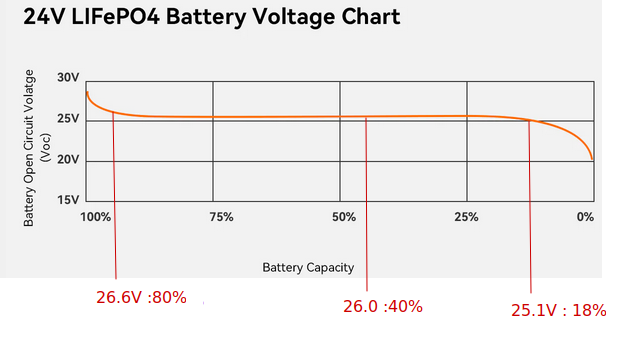
If you look at Voltages, the difference between 26.6V and 25.1 V is not much. This is why you need a solid connection. A difference of 0.5 Volt between the battery and the Inverter as a drop, means the low cut voltage is false, at the wrong reading. I am wondering if I should set the low voltage cut off to 25.05 to allow for the voltage drops across the fuse holder and wire length, this way the Inverter get a full discharge from the battery capacity correctly? Shalom for now.
|
Created by Rob Thompson. Hosted since 10/01/2012. Visitors HOSTED by Prologic, my Son. A thin website.